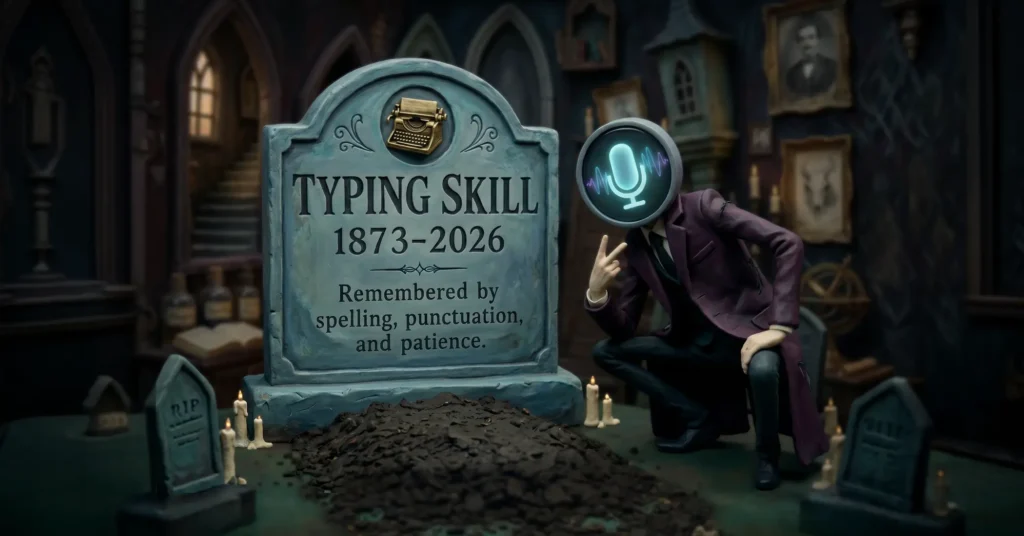
Based on Gen-Z’s digital behavior, typing skills might be the next victim on the road to extinction 🪦, and soon it may be treated more like a niche craft than a useful skill.
👀 What I’m Noticing
The shift is simple: younger people are moving from ⌨️ keyboards to 🎙️ voice.
On phones, dictation is already normal. On laptops, it’s catching up fast. And with AI cleaning up rough speech into clean text, the old reason to type everything is getting weaker. 🎙️✨
It almost feels like the keyboard is being kept around just for searching, fixing typos, and dropping emojis into dictated messages.
The habit is starting to shift not because typing is bad — just because voice is getting good enough to replace it in a lot of everyday situations.
The Tools Have Gotten Good
The tools around it have improved a lot. Modern dictation apps are no longer just raw speech-to-text. They can take a messy, unfinished thought and turn it into clean writing. You speak loosely, the app tightens the grammar, adds punctuation, and makes the result readable.
The gap between “what I said” and “what I meant” is getting smaller.
“Voice is transforming the way we think and create.”
— Steven Bartlett, host of Diary of a CEO, on Wispr Flow, which “quickly became an essential part of how I work.”
That detail says a lot. This shift is not only about Gen Z sending voice notes. It is also about founders, creators, and operators trying to remove friction between thinking, deciding, and communicating.
Big Players Are Leaning In
Even Google seems to be leaning into this shift. At the latest Android I/O 2026, it introduced “Rambler” ✨, a dictation feature that uses Gemini to turn messy speech, filler words, and even mid-sentence corrections into clean text in real time.
That feels like a pretty clear sign that voice input is no longer just an accessibility feature or a backup plan. It’s being treated like a primary way to write ✍️.
So Where Does Typing Go?
Typing might not disappear, but it may become one of those skills people rarely need, yet still respect — something between a craft and a flex. A little less practical, a little more distinctive.
That’s why this feels bigger than just a change in input method. It’s a sign that the way we write is changing, and the way we think about writing is changing with it.
My only concern: what happens to spelling, punctuation, and grammar when we stop practicing them as much and let the voice do all the work? 🤔