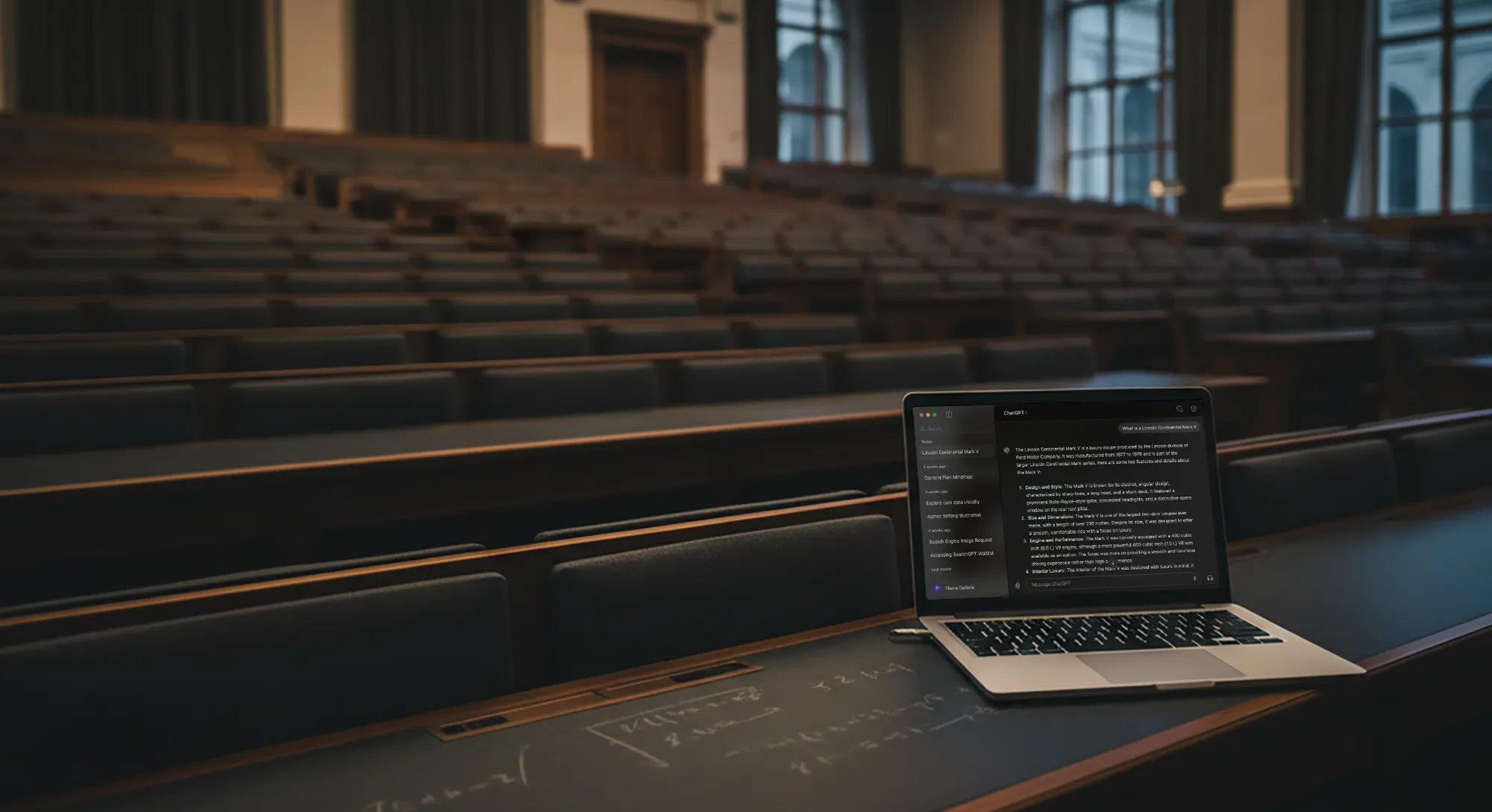
In recent months, one trend in education has stood out to me more than anything else. Institutions are splitting into two very different camps when it comes to AI.
On one side, some professors and schools are trying to “AI-proof” their courses with detection tools, strict policies, and bold warnings that signal resistance.
On the other side, others are testing AI platforms, creating guidelines, giving students structured access, and trying to understand how these tools actually work in practice.
That divide is worth paying attention to.
Education has always been about helping people understand the world and navigate it more intelligently. And because AI is now part of that world, it can’t simply be treated as an outside threat.
Large language models are already embedded in daily life. Students use them. Professionals use them. Entire industries are being reshaped by them.
So the question may no longer be:
“How do we stop students from using AI?”
A better question is:
“How do we design learning in a world where AI already exists?”
These systems do have real limitations. They do not truly think, and they do not understand context the way humans do.
They predict patterns. They generate probabilities. They can be helpful assistants, but they are not independent thinkers.
And that is exactly why educators should understand them deeply instead of rejecting them from a distance.
This is ultimately a question of pedagogical design. More specifically, it is about building AI-augmented learning environments where technology supports deeper thinking instead of replacing it.
The goal is not to let AI do the learning for students.
The goal is to design learning experiences where students still have to think critically, solve problems, and make judgment calls that AI cannot make on its own.
A simple example makes this clear. If a course is built around producing one written article every week for seven weeks, an LLM can complete much of that task in seconds.
If that assignment is the core of the learning experience, then the real problem is not the tool.
The problem is the course design.
Now imagine a different model.
A course built around solving real problems, defending arguments in live discussions, building projects, reflecting on process, critiquing AI-generated outputs, and improving them through human judgment.
In that kind of environment, AI becomes a support system rather than a shortcut.
The focus shifts from producing text to producing thought.
Maybe that is the deeper shift happening here. This moment may be about more than AI itself.
It may signal a broader evolution in education toward models that naturally value critical thinking, creativity, adaptability, and judgment more than repetitive output.
In that future, AI is simply one tool among many.
The opportunity is the same across the entire education system. From universities to primary schools, educators do not need to fight these tools as if resistance alone will solve the problem.
They need to understand them.
They need to experiment with them.
They need to become fluent in both their capabilities and their boundaries.
When teachers master the tool, students have a much better chance of learning how to use it responsibly.
And in 2026, that may be one of the most important skills education can teach.