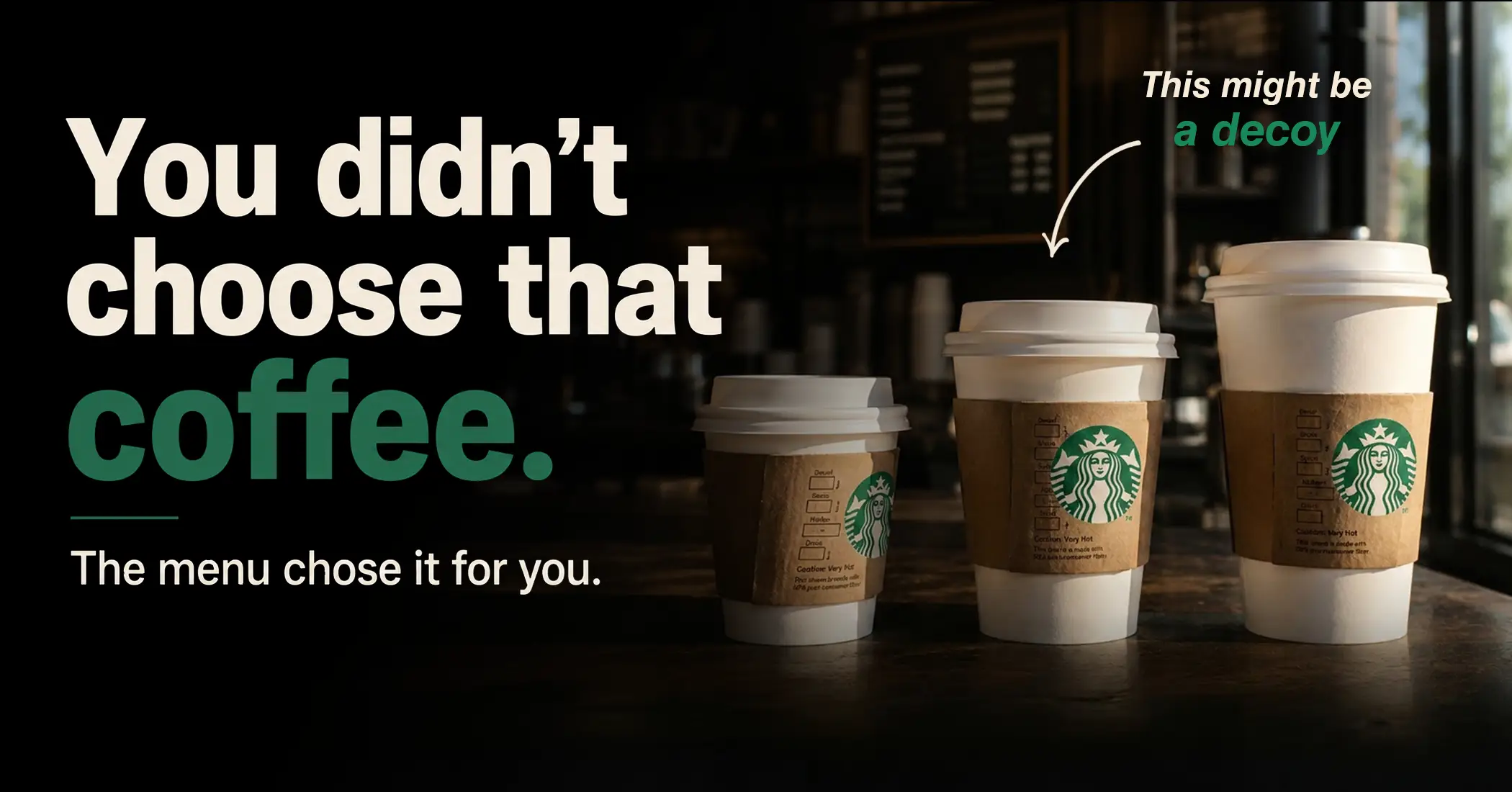
Have you ever noticed that when you walk into Starbucks, you almost always end up reaching for the bigger one, the Venti, even when you meant to keep it simple? Not the small, which feels a bit stingy. Somehow, you keep sizing up.
That was not entirely your decision. The menu shaped a lot of it on purpose, and it does this to most people, even the ones who study it for a living. Once you see the trick, you start noticing it everywhere.
The three sizes are not what they seem
Starbucks gives you three sizes for most drinks: Tall, Grande, and Venti. On the surface, that just looks like small, medium, and large. Underneath, it is a piece of design, and the design lives in the numbers.
Take an example: a Tall might be €5.30, a Grande €5.90, and a Venti €6.50. Each step up costs about 60 cents, and each step gives you roughly 120 ml more coffee. That makes the Grande look like a smart upgrade from the Tall, and the Venti look even better next to the Grande.
The small size fades into the background. It is there, but it does not feel like the “real” choice. The menu nudges you toward the option the company would most like to sell.
You are not just choosing a size, you are responding to a carefully structured comparison designed to make one option feel like the smartest move.
The decoy effect
Behavioral economists call this the decoy effect. The idea is simple: add a third option that nobody really wants, and it changes how people judge the other two.
You stop comparing the drink to some fixed sense of value and start comparing the options sitting next to each other. That comparison is what drives the choice. Well designed decoys can shift preference a lot.
The popcorn version makes it obvious
The same thing shows up at the cinema. If you offer:
- A small popcorn for €5.90
- A large for €8.50
Many people pick the small.
Add a medium for €7.90, and the large suddenly looks like the obvious deal. The medium is not really there to sell. It is there to make the large feel reasonable.
Where else you’ll see it
Once the pattern is in your head, you will spot it everywhere:
- Pricing pages with three plans
- Car trims that make the next model up look sensible
- Apartment listings that make the “less bad” option feel like relief
The middle choice often exists to steer you, not to win you.
There is a famous research version from behavioral economist Dan Ariely. A magazine offered web only for 59 dollars, print only for 125 dollars, and print plus web for 125 dollars. The bundle cost the same as print alone, which makes print only look pointless, and that was the point. With the decoy in place, 84% chose the bundle. Remove the “useless” print only option and most people flipped to the cheap web only plan. One line on a page, steering the whole room.
The honest part nobody tells you
Knowing about the decoy effect does not make you immune to it. Researchers who have spent careers on this still reach for the Venti. Naming a bias and being free of it are two very different things.
So the goal is not to outsmart every menu. You will lose that game. The goal is smaller: to notice the moment the effect is working on you, and slow down for a beat inside it. That moment has a signature. It is the three option choice, with a comfortable one nestled in the middle.
Awareness does not remove the bias, but it creates a small window where you can choose more deliberately.
One small thing to try this week
The next time you are facing three prices, stop on the middle option and ask one plain question: is this the one I genuinely want, or the one I was steered toward?
Sometimes the middle really is right for you, and you will take it with a clear head. Other times you will notice you were being walked somewhere, and you will step off the path. Both are wins, because in both you were the one deciding.
The bottom line
You do not need to beat the menu. You just need to know when you are the one choosing and when the choosing is being done for you.