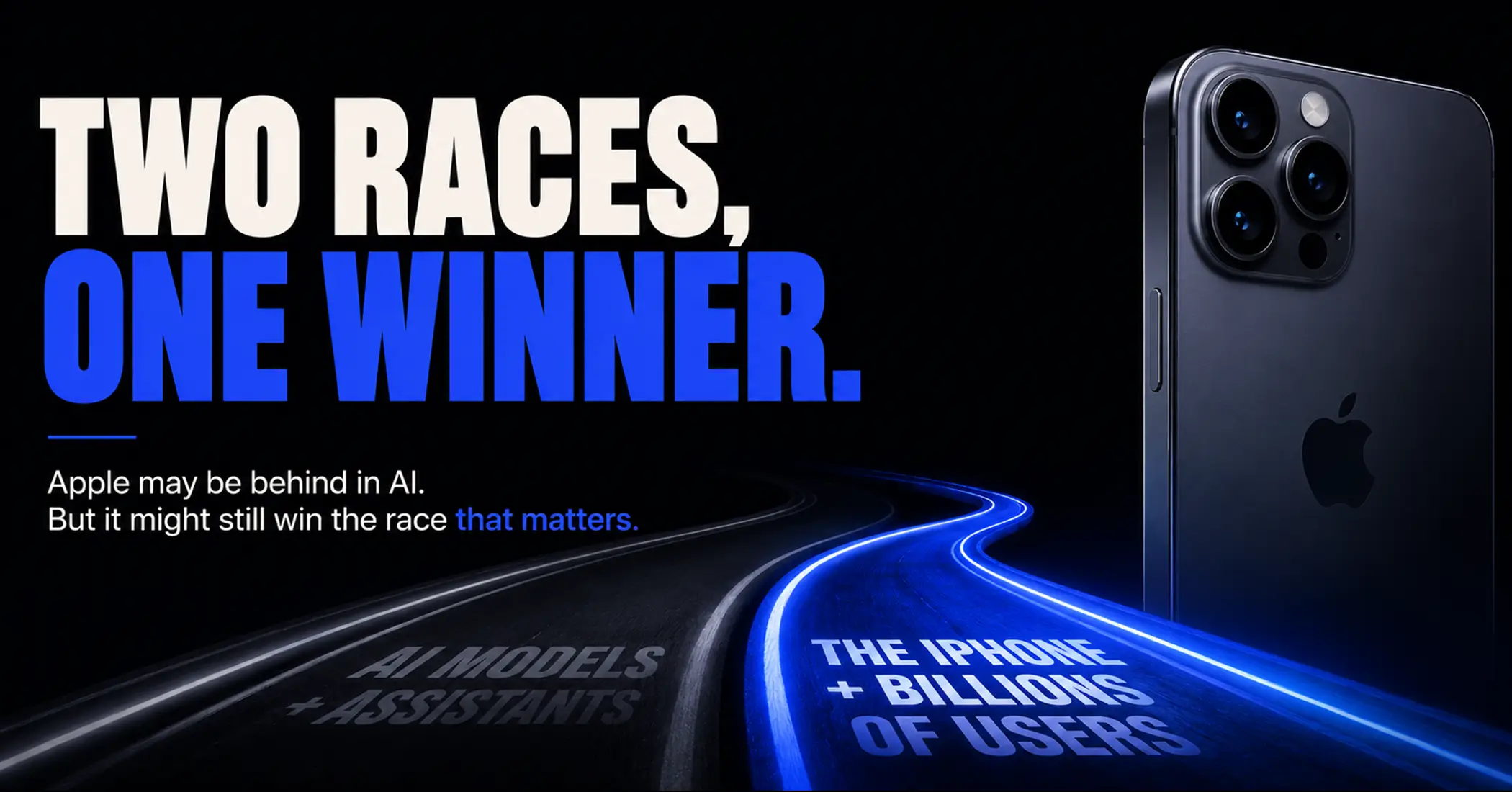
Did Apple lose the AI race? That depends entirely on which race you think it is trying to win.
That is the honest version. Most people think the answer is obvious: Apple blew it. And if you are judging by the race the rest of the industry is obsessed with, that is a perfectly reasonable conclusion.
The case against Apple
Start with the case against Apple, because it is strong.
When ChatGPT arrived, the rest of big tech reacted immediately. Google sped up. Meta went all in. Even Bing had its brief moment of chaos and ambition. Apple, by contrast, mostly stayed quiet. For a long time, it seemed hesitant even to say AI out loud.
Then it introduced a smarter Siri and still did not fully deliver it. Nearly two years later, that overhaul remains incomplete, and Apple reportedly ended up leaning on Google’s models to help make it work. That matters. This is the company that built its reputation on owning the whole stack, and now it is apparently paying a rival around $1 billion a year to handle a core part of its assistant.
If Company A is paying Company B a billion dollars a year to do the hardest part, Company B has already won that race.
In the race for frontier models and AI assistants, Apple lost. That part is not really debatable.
The wrong race?
But that may also be the wrong race to judge Apple by.
Apple is not, at its core, a model company. It is a hardware company. More specifically, it is the iPhone company. And AI never posed the same existential threat to that business that it did to something like search.
People do not buy iPhones because they love the chatbot. They buy them because they want the phone.
Seen through that lens, Apple Intelligence does not need to be best in class. It just needs to be good enough that investors believe Apple is still in the game, and good enough that existing customers do not feel like they are falling behind.
Where Apple falls short
By the standard of the most impressive AI experience available, Apple looks weak. By the standard of defending the iPhone franchise, Apple may be doing just enough. Those are two very different tests.
If you genuinely care about AI features right now, there are better phones on the market:
- Pixel offers advanced assistant capabilities and tight AI integration.
- Samsung delivers strong writing tools and feature depth.
- Xiaomi pushes competitive on-device AI features and image editing.
Still, most of these features feel more like demos than deciding factors. Very few people are switching phones because of slightly better generative editing or writing tools. The gap is real, but it is not clearly costing Apple significant sales yet.
Two different races
This debate makes more sense when you separate it into two races:
- The software race: models, assistants, and user-facing AI experiences. Apple is behind here.
- The hardware race: who controls the device AI ultimately lives on. This race is still unfolding.
Right now, most AI runs in the cloud. But over time, the most useful forms may become more local, faster, more private, and less dependent on constant connectivity. If that shift happens, the real advantage will belong to whoever controls the device layer.
The long-term prize is not just building the best model. It is owning the device people trust to run that intelligence every day.
And in that race, making the iPhone is a major advantage. Apple does not own search either, and that never stopped it from owning the device people use to search. The same logic could apply to AI.
Siri’s real advantage and limits
The new Siri, for all its shortcomings, does have one meaningful edge. It can access personal context more naturally, including messages, calendar data, and photos. That level of integration is difficult for standalone AI apps to match.
But the limits are just as clear. Siri is not best in class at anything that reshapes expectations. It does not match the capability or flexibility of tools like ChatGPT or Gemini. It does not behave like a true autonomous agent, and its memory of the user still feels limited in practice.
The real verdict
If the question is whether Apple lost the AI race everyone has been watching, the answer is yes. In models and assistants, Apple is behind, and relying on a direct rival makes that harder to deny.
But if the question is whether Apple is doomed in the race that will matter most to its future, the answer is far less clear. The long game is about where AI lives, how much runs on-device, and which company controls the hardware people refuse to leave.
That is why writing Apple off completely is premature. But pretending it is safe is just as questionable.
The bottom lineThe more interesting question is not whether Apple already lost the last race. It is whether an AI company can build hardware compelling enough to pull people away from the iPhone, or whether Apple can make its AI just good enough to keep them exactly where they are. That is the race worth watching. The other one may already be over.