There is a persistent assumption in how we talk about AI education: that the goal is to produce more people who can build AI systems. The talent pipeline is the default frame.
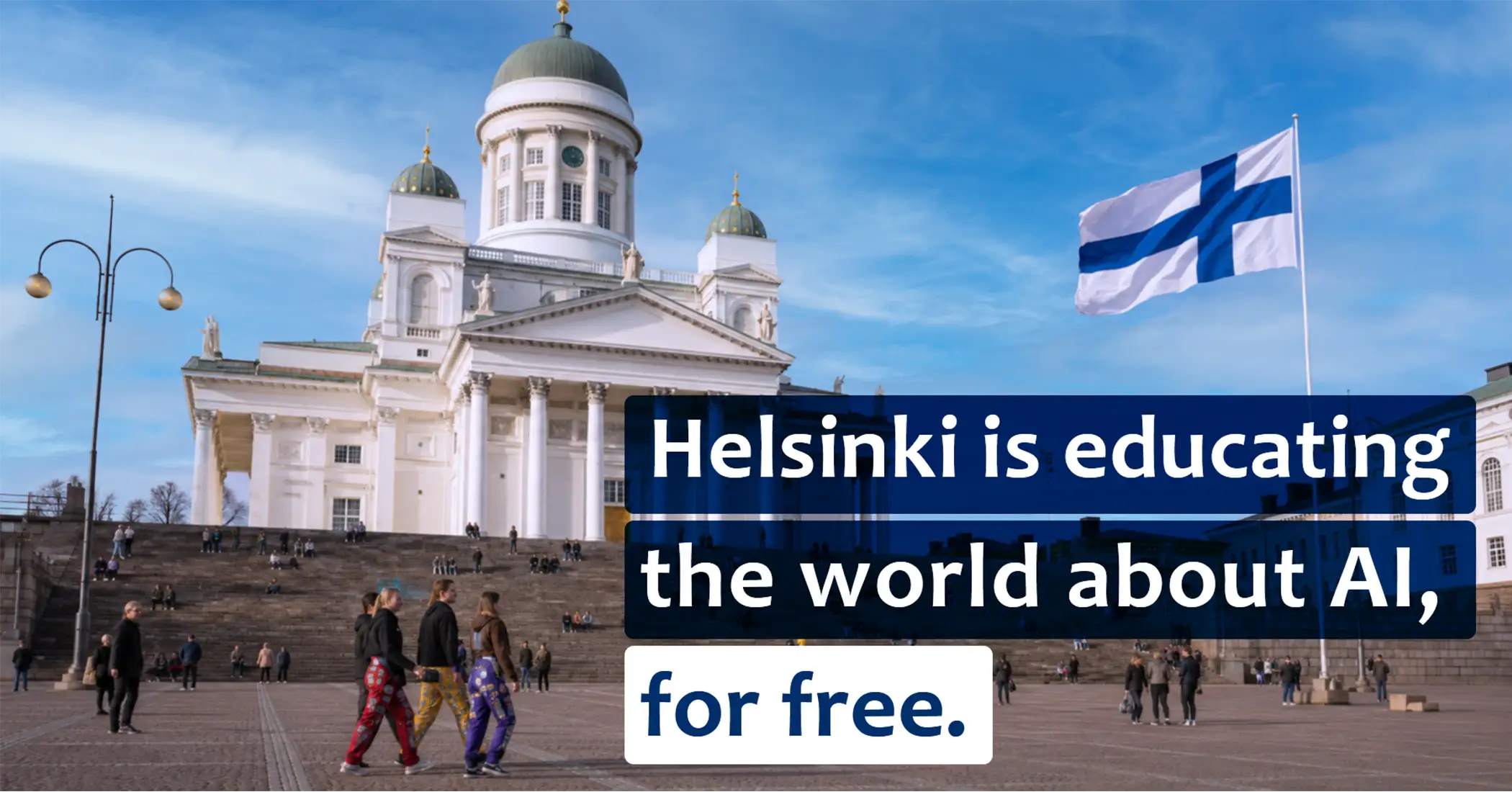
Finland built something on a different question: who should understand AI well enough to have a say in how it is used?
“We will never be the leader of artificial intelligence. But how we use it, that is something different.”
— Mika Lintilaa, Economy Minister
The goal was not to win the AI race. It was to ensure citizens could participate in forming the decisions AI was making for them.
A Course Built as a Public Good
That framing produced Elements of AI, a free non-technical course launched in May 2018 by the University of Helsinki and Helsinki consultancy Reaktor. The original target: 55,000 Finns, 1% of the adult population. Hit within months.
Eight years later, 2 million people from 170 countries have enrolled. The course runs in 30 languages. It has never charged a fee.
By the numbers- 2 million learners across 170 countries
- 30 languages, and no fee, ever
- Original goal of 55,000 Finns met within months
Who Actually Showed Up
The demographics tell the real story. Forty percent of learners are women, against a baseline of roughly 17% for CS MOOCs per HarvardX/MITx data. A quarter are over 45. In Finland, women have been approximately 60% of participants.
This was deliberate. Lead instructor Professor Teemu Roos designed the course for people who were not already interested in AI. Not developers, but the cross-section of society governed by AI without ever producing it.
“We wish to engage people in this transformation instead of them just adapting to the doings of a technological elite.”
— Professor Teemu Roos, Lead Instructor
How It Pays for Itself
The funding model reflects the same logic: a public-private-EU hybrid. The Finnish Ministry of Economic Affairs and Employment contributed approximately 1.68 million euros. The European Commission translated the course into all 24 official EU languages. MinnaLearn, which spun out of Reaktor Education in 2022, cross-subsidizes the free course through corporate licensing.
From National Project to European Baseline
In late 2019, Finland held the EU Council Presidency. Employment Minister Timo Harakka made Elements of AI the formal parting gift to fellow member states. By April 2021 it was live across 22 EU countries.
Since February 2025, that decision carries regulatory weight. Article 4 of the EU AI Act requires every provider and deployer of AI systems in Europe to ensure staff maintain a sufficient level of AI literacy. Elements of AI is now the de-facto European baseline for what that looks like in practice.
One caveat: the 2 million figure is enrollment, not completion. Global completion runs around 16% — strong by MOOC standards, but not the same as 2 million trained.
Why It Worked
Elements of AI did not scale by optimizing for scale. It scaled by treating AI education as a civic problem rather than a pipeline problem.
“A key idea of our university is that science and learning belong to everybody.”
— Rector Sari Lindblom
That is not marketing. It is the reason a 380-year-old Nordic institution, rather than a hyperscaler, ended up setting the standard.