A marketing read on Apple’s new child-account controls from WWDC 2026, and why the smartest growth strategies no longer look like marketing at all.
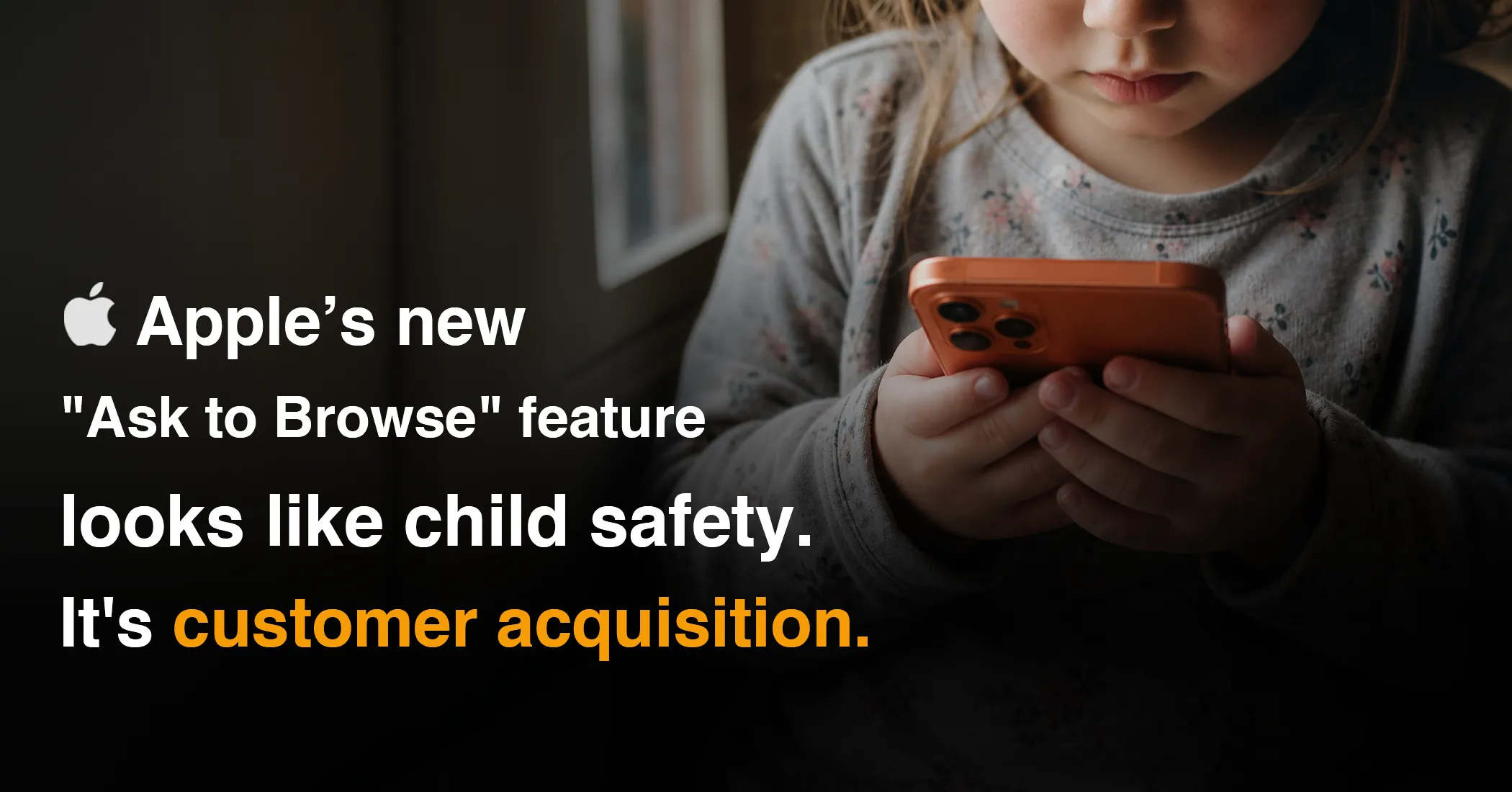
At WWDC 2026, Apple announced a set of child-safety upgrades that, on the surface, read as a parental win. The headline addition is a feature called “Ask to Browse.” On a child’s account, Safari now blocks most websites by default, and a parent has to approve each new one individually, using the same consent model Apple already applies to App Store purchases through “Ask to Buy.” Alongside it came tighter communication controls across Messages, FaceTime, and Phone, age-appropriate media tiers, and a redesigned Screen Time. The features are on by default for children under 13 and ship this fall with iOS 27, iPadOS 27, and macOS 27.
As a parent, I think this is genuinely useful. As someone who looks at markets for a living, I think it is something else entirely. This is one of the most patient customer-acquisition moves I have seen from a company this size, and almost nobody is describing it that way.
The distinction that changes everything
Most companies acquire customers who can already buy. Apple is acquiring customers who cannot.
A nine-year-old is not a decision-maker. They do not have a credit card, a salary, or a vote in the family budget. By every conventional definition of a target market, they are not worth acquiring. And yet a nine-year-old who learns the digital world through an iPhone becomes a sixteen-year-old with years of photos, messages, app habits, and muscle memory living inside a single ecosystem. By the time they are an actual buyer, the decision has already been quietly made for them.
That is the move. Apple is not selling a phone to a child. It is lowering the lifetime probability that this person ever chooses anything else.
This is switching cost, not loyalty
It is tempting to call this brand loyalty, but loyalty is the wrong frame. Loyalty is a feeling, and feelings are cheap to change. What Apple is building is switching cost, and switching cost is structural.
The longer someone lives inside a system, the more expensive it becomes to leave. That expense is rarely measured in dollars. It shows up as friction, as the photos and messages that do not transfer cleanly, as the relearning of a different interface, as the iMessage thread that breaks when one person leaves. Every year a child spends inside Apple’s ecosystem raises that exit price a little higher. By adulthood, the cost of leaving is not a purchase decision. It is a migration project, and most people never undertake it.
In customer-lifetime-value terms, Apple is not optimizing the next sale. It is extending the entire relationship, starting it a decade before the first transaction and engineering it to compound.
The genius is in the channel
What makes this strategy sharp is not the lock-in itself. Lock-in is old news. The sharp part is the channel through which the acquisition happens.
Apple is not advertising to children. That would be both unsettling and, in most markets, heavily regulated. Instead, it is solving a real and growing anxiety for the actual buyer, the parent, and letting that solution do the acquisition quietly. Parents today cannot reasonably keep children off devices; technology is now a daily utility, not a luxury to be withheld. What parents can do is choose the environment their child grows up inside. Apple just made itself the obvious, lowest-anxiety choice for that environment.
The feature earns two things at once. It earns trust from the decision-maker, and it earns familiarity from the future customer. One product, two audiences, separated by a decade. That is unusually elegant.
This is product-led, value-led acquisition in its purest form. There is no campaign to run, no media to buy, no message to push. The product is the marketing. We rarely see this executed well, because it requires a company patient enough to invest in a customer who will not show up on a revenue line for years.
Why this is the opposite of marketing myopia
In 1960, Theodore Levitt wrote that companies decline when they define themselves by the product they sell today rather than the need they actually serve. He called the failure marketing myopia, and the graveyard is full of its victims. Kodak optimized film and missed photography. Nokia optimized handsets and missed the smartphone. The American railroads believed they were in the railroad business rather than the transportation business, and watched the future leave on highways and in airplanes. Each of them won the present and lost the shift.
Apple is doing the inverse. It is defining itself by a need, child safety in a world where children cannot be kept offline, and building for a customer who will not matter commercially for a decade. It is treating a side issue most competitors ignore as a front door. That is not myopia. That is the longest possible field of vision, executed through a feature that happens to be genuinely good for the people it serves.
The real question
So the real question is not whether Apple’s feature protects children. It does, and that matters. The more interesting question is what we should call a strategy that grows a company by sincerely serving a need its rivals treat as an afterthought.
We usually define good marketing as the art of persuasion, of convincing someone to choose you. The more durable version is quieter and far harder to compete against. It is the art of being chosen before the choice is ever conscious, by building real value into the moment a future customer first encounters the world.
That is the game Apple just made a move in. The fact that it looks like a safety setting, and not like marketing at all, is precisely what makes it work.