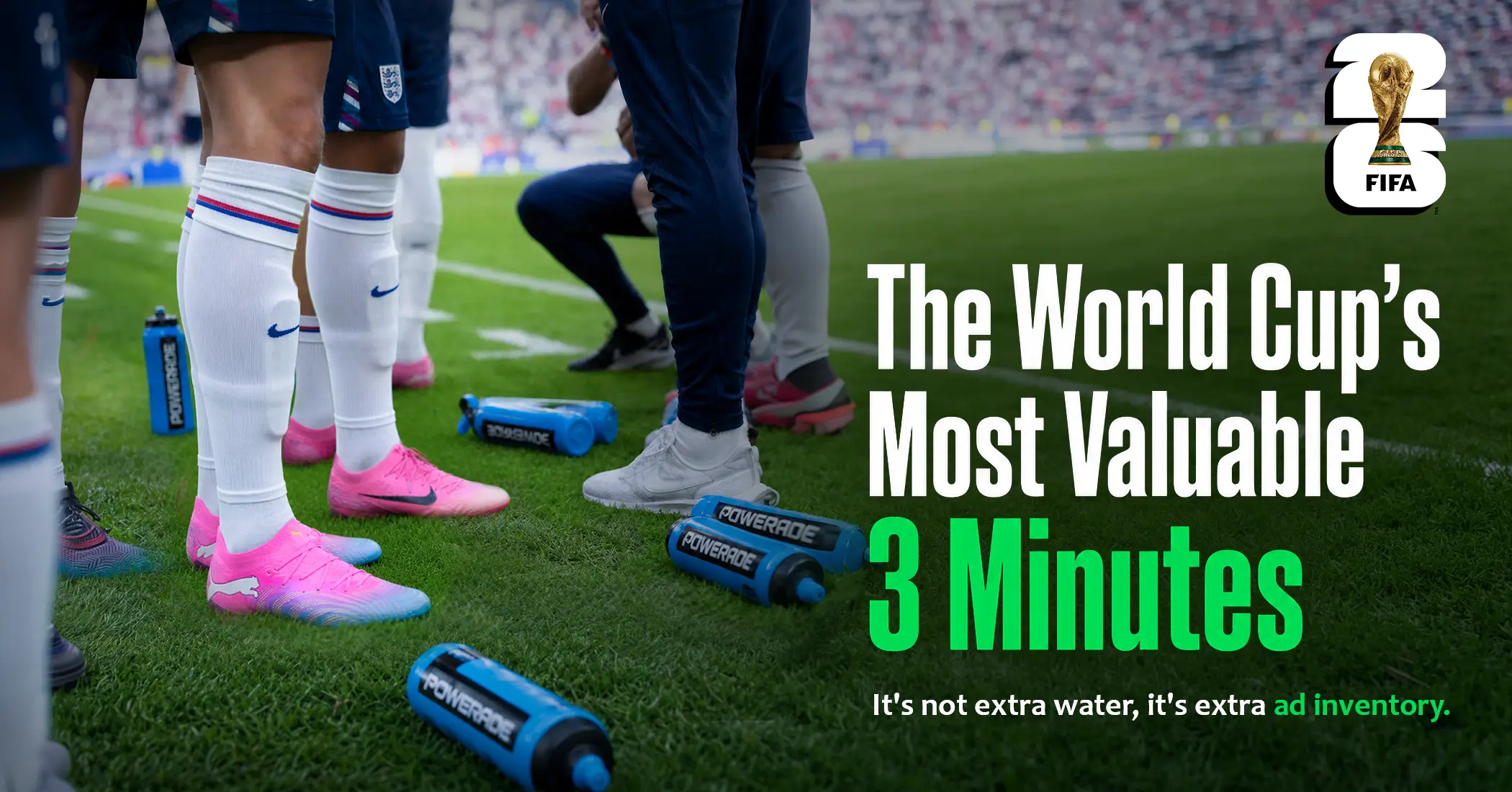
FIFA’s explanation for the World Cup’s mid-half pause is player welfare. Give the players water, cool them down, protect them from North American heat. It’s a reasonable-sounding policy, and nobody would object to it on its face.
Then you watch a match played indoors, in a climate-controlled stadium, at a comfortable 68 degrees. The break still happens. FIFA’s justification for that: “sporting integrity.” Every match needs the same rules, so every match gets the pause, regardless of whether anyone on the field is actually at risk of overheating.
That’s the detail that gives the game away. A safety measure that applies whether or not the underlying danger exists isn’t really a safety measure. It’s a format. And formats get built for a reason. In this case, the reason is money, and the number is large enough that it’s worth being precise about it.
The mechanism, in plain terms
Each hydration break is a mandated three-minute stoppage, once per half. Broadcasters are allowed to run advertising starting 20 seconds after the whistle blows and ending 30 seconds before play resumes. Do that math across a full match and you get roughly eight extra 30-second ad slots per game that wouldn’t otherwise exist. Multiply across the tournament’s full match count and the total comes out to 832 additional ad slots, more than seven and a half hours of extra ad-adjacent airtime across the competition.
Fox Sports, the US rights holder, has been using nearly all of that inventory. A 30-second slot during a hydration break runs $200,000 to $300,000. During USA matches and the knockout rounds, when attention spikes, the price climbs to $750,000. Add it up across the tournament and the estimate lands close to $250 million in US ad revenue from hydration breaks alone. One industry estimate, from a Wharton sport-management lecturer, puts the global figure across every broadcaster in every market at somewhere near $1 billion.
For context: Fox paid $485 million for the US broadcast rights to this World Cup. If the hydration breaks alone are generating something in the neighborhood of $250 million, they’re covering roughly half the cost of the rights deal by themselves. One sports-media analyst put it bluntly: at that price, the rights fee looks like “a real bargain.”
“At that price, the rights fee looks like a real bargain.” — a sports-media analyst on Fox’s $485M rights deal
Who gets the ads, and who doesn’t
Not every audience sees this the same way, and the split is instructive. In the UK, viewers are mostly shielded. The BBC carries no advertising at all, and ITV’s ad inventory is capped by Ofcom regulation, which limits how many commercial minutes it can run per hour regardless of what happens on the pitch. Telemundo, the US Spanish-language broadcaster, made a deliberate choice not to run ads during the breaks, opting instead to keep cameras on the crowd and the players.
Everywhere else, broadcasters took the inventory. Fox has gone further than simply running ads, packaging the breaks themselves as “sponsored by” placements, layering a third revenue stream on top of the ad slots: FIFA’s own official sponsor, Coca-Cola, supplies the branded drinks players are shown consuming on camera. Viewers in some markets are effectively watching three overlapping commercial messages stacked into a break that’s nominally about rehydration.
Why this isn’t a one-off
It would be easy to treat this as a quirky footnote to one hot-weather tournament. The people who study sports media rights don’t see it that way. The breaks hand FIFA something more durable than a single ad-revenue windfall: leverage in every future negotiation.
Broadcasters now know a World Cup rights package comes bundled with a built-in, sellable ad unit that didn’t exist in past tournaments. That makes the rights themselves worth more, and FIFA can price the next deal accordingly. The 2030 World Cup, co-hosted by Morocco, Spain, and Portugal, will also include host cities with hot summers, which gives FIFA a straightforward, defensible reason to keep the policy in place. Nobody involved in structuring these deals has an incentive to walk it back. As one media-rights author put it, when there’s a way to make more money, nobody chooses to make less.
The part that gets lost
None of this means players are never at genuine risk in the heat, or that a cooling break is inherently a bad idea. Some matches in some cities plainly warrant one. The problem isn’t the concept. It’s the framing, and the fact that the framing doesn’t survive contact with how the rule is actually applied.
Managers have noticed. Pochettino, the USA’s manager, called the breaks “unnecessary” outside conditions of genuine extreme heat. Players have grumbled through them. Fans have jeered. In at least one match, Fox’s own broadcast missed the restart because its ad break ran long, which is its own small piece of evidence about which side of the equation actually drives the schedule.
The real takeaway
Hydration breaks are annoying because they interrupt the rhythm of a match for reasons that don’t always hold up. But the annoyance isn’t a bug in FIFA’s plan. It’s the plan working as intended.
The bottom line
A three-minute stoppage, applied uniformly regardless of conditions, timed precisely to fit a sellable ad format, generating hundreds of millions of dollars for broadcasters and leverage for FIFA’s next negotiation, isn’t primarily a welfare policy. It’s a monetized unit of inventory that happens to include a water bottle.